A commercial interior needs more than a colour choice: the stainless grade, embossing, coating system, thickness, fixing method, lighting, and cleaning regime all affect the result. By the end, you will be able to match colored embossed SS sheets to specific property areas, reject unsuitable alternatives, and prepare a fabrication and purchasing brief that protects appearance and service life.
Key takeaways
- Match surface texture and colour to traffic, lighting and cleaning demands.
- Use Grade 316 where salt exposure or aggressive cleaning threatens Grade 304.
- Confirm thickness, backing, joints and fabrication details before releasing panels.
- Approve a full-size mock-up and panel schedule before site installation.
Where Color Embossed Stainless Steel Sheets Work Best in Mumbai Properties
Color embossed stainless steel sheets in Mumbai suit commercial areas where a durable visual feature matters more than a perfectly smooth surface. Colored embossed SS sheets work well in these locations:
| Area | Why it works | Check before specifying |
|---|---|---|
| Lift surrounds | Texture hides minor marks and adds depth | Repeated impact, trolley contact, cleaning frequency |
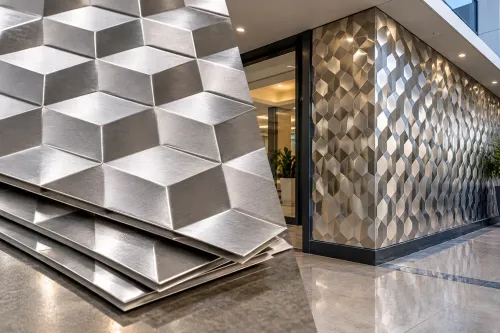
| Reception walls | Creates a branded focal surface | Protected indoor exposure and glare from luminaires |
| Retail feature walls | Draws attention without relying on graphics | Fingerprints, display fixtures, and replacement access |
| Column cladding | Gives structural elements a finished appearance | Panel joints, corner impact, and fixing clearance |
| Restaurant and café interiors | Adds colour and texture to food-service spaces | Grease, steam, saline wash-down, and cleaning chemicals |
| Restroom areas | Resists moisture when detailed correctly | Condensation, disinfectants, chloride-bearing bleach, and drainage |
| Door panels | Provides a hard-wearing decorative face | Repeated hand contact, knocks, hinges, and edge wear |
| Signage backdrops | Improves contrast behind letters and logos | Drilling, adhesive compatibility, and outdoor air exposure |
Do not specify by colour name alone. Separate the stainless grade, base thickness, embossing pattern and direction, surface finish, colour coating, panel size, and fixing method. Colour and embossing are appearance decisions; grade and construction determine suitability.
Identify sea air, condensation, saline wash-down, pool chemicals, vehicle-borne contaminants, and repeated impact before approval. Confirm whether the finished panel is a solid sheet, folded panel, or sheet bonded to a backing or core after fabrication. A protected indoor wall needs a different construction from a coastal or high-contact installation.
How to Choose the Surface, Colour and Material for Each Application
Choose the material by contact, lighting and repair risk, not by colour name alone. Embossed texture changes shadows and cleaning effort; colour production is a separate decision.
PVD colours are surface coatings on stainless steel, not changes to the alloy, so scratches, exposed edges and drilled holes can show coating damage while the substrate remains intact.
| Option | Strength | Limitation |
|---|---|---|
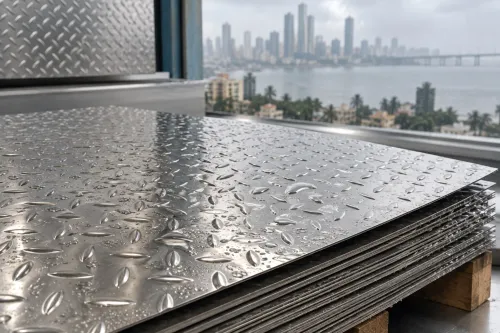
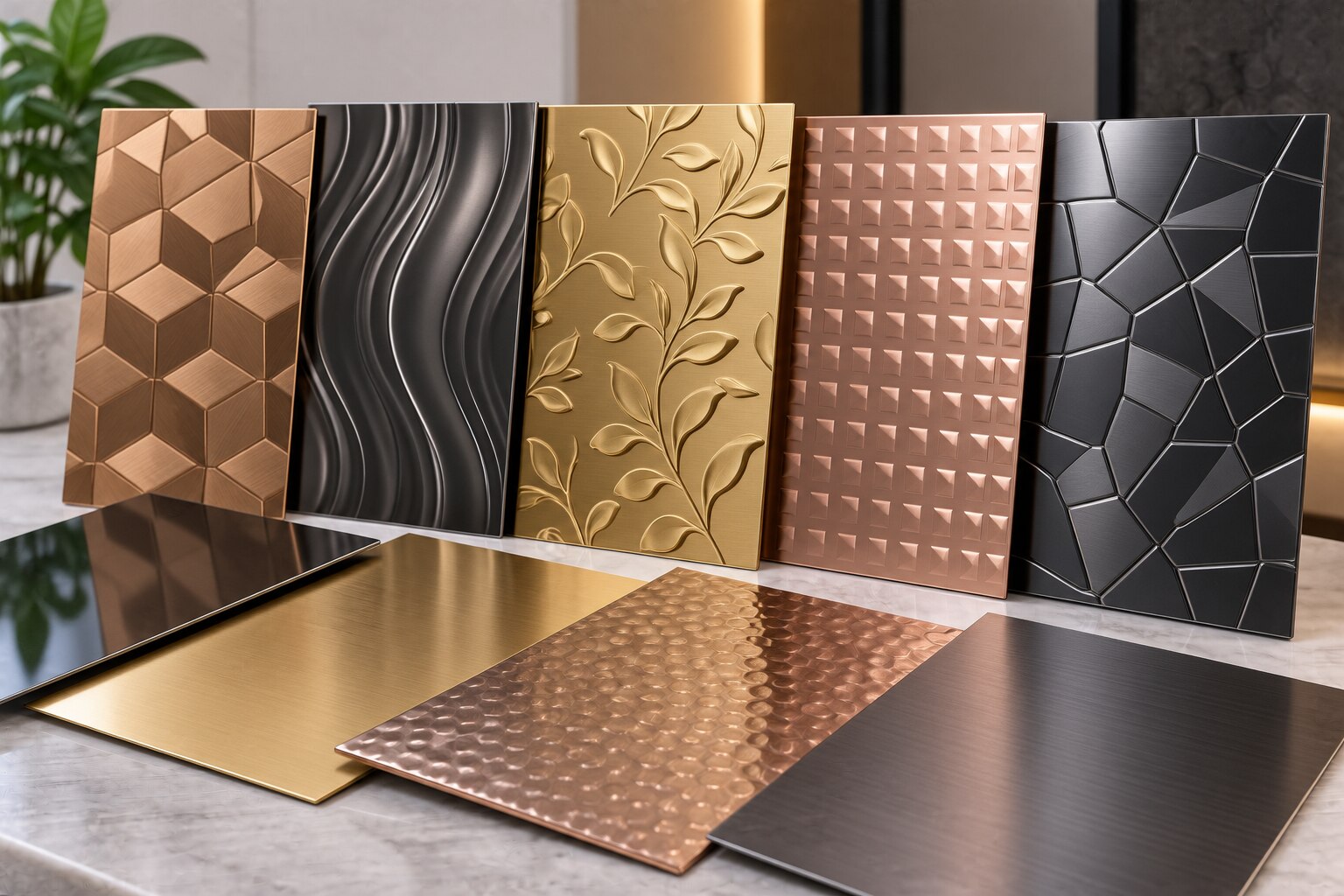
| Colored embossed SS sheets | Strong designer impact and depth | Recesses collect dust, fingerprints and cleaning residue |
| Plain embossed sheets | Texture without strong colour contrast | Less visual drama; pattern direction still matters |
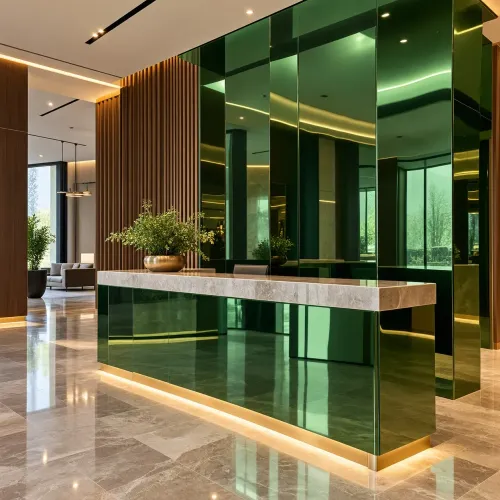
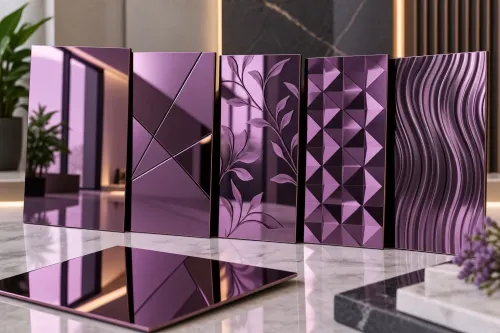
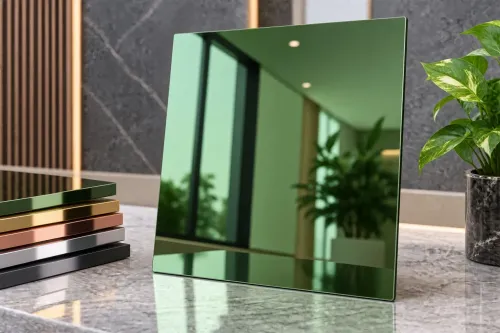
| PVD-coated mirror sheets | Deep colour and enlarged room appearance | Glare and fingerprints are prominent; scratches are conspicuous |
| Etched sheets | Controlled pattern with refined contrast | Etched areas still need careful cleaning |
| Paint-coated metal | Broad colour choice and simpler touch-up | Abrasion, fading, chipped edges and repairs depend on the paint system |
| Aluminium composite panels | Light, economical large panels | Core, edges and impact behaviour differ from solid stainless |
| Laminate | Easy colour matching and replacement | Lower resistance to moisture, heat and impact |
| Ceramic tile | Washable, hard surface | Grout lines, breakage and limited large-format detailing |
| Natural stone | Unique, premium appearance | Heavy, variable, porous and costly to replace |
Mirror surfaces maximise glare and perceived scale; brushed and hairline finishes reduce reflections and hide handling better. Textured surfaces break highlights but reveal uneven lighting across high points and recesses.
Bronze, black, champagne, gold and other dark colours expose dust, fingerprints, scratches and patchy reflected highlights differently. Test a representative panel in daylight, warm lighting and the installed luminaires. Select the high-impact finish only when its cleaning burden and replacement risk are acceptable.
Thickness, Backing and Fabrication Details That Prevent Site Problems
Match thickness to the support and abuse, not to a universal rule. A 0.5–1.0 mm sheet reduces material cost, dead load, cutting effort and bending effort, but dents more readily and needs a flat substrate or rigid backing.
A 1.5–3.0 mm sheet resists impact and holds folded returns better, while increasing cost, weight, cutting force, transport effort and installation labour. Use lighter construction for protected wall features; use rigid, replaceable panels for lift surrounds, doors, columns and impact-prone zones.
For decorative steel sheets for developers, require a coordinated detail before fabrication:
- Show the backing frame, substrate flatness tolerance, ventilation cavity, adhesive or mechanical fixing, compatible fasteners, isolating washers or sleeves, folded returns, corner profiles, joint width, expansion allowance, drainage and access to replace one damaged panel.
- Record embossing direction, panel numbers, batch control and reflected-light continuity. Adjacent colored embossed SS sheets from different coil directions can create broken patterns and abrupt highlights.
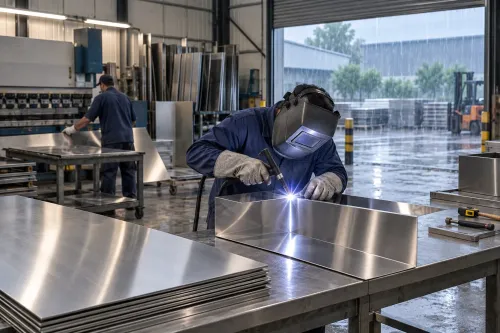
- Specify factory-cut dimensions and the approved sequence. Shearing, drilling, punching, tight-radius bending, welding and site grinding can crack, burn or remove a coloured coating.
Qualify the actual tools, bend radius, protective film and fabrication sequence on a sample. Minimise field modification with factory-cut panels; otherwise a small site adjustment can turn a matching panel into a visible replacement, especially around lifts and doors.
When Grade 304 Is Enough—and When Mumbai Projects Need Grade 316
No: Grade 304 is not suitable for every Mumbai commercial location. It suits many indoor and sheltered walls, but choose 316 or 316L for sea-facing façades, salt-laden air, swimming-pool surroundings, saline cleaning, persistent condensation, or aggressive chemical exposure.
Make the quotation identify the material, not just ASTM A240/A240M. State the exact grade, thickness, finish, and required mill certificate.
For coloured or PVD surfaces, request:
- The coating family or deposition system and intended environment
- Colour tolerance, adhesion-test method, and abrasion expectation
- Protective-film type, removal timing, and a replacement allowance with matching spare panels
ASTM B117 salt-spray results do not prove performance on formed edges, drilled holes, cut-outs, or installed fixings when those areas were excluded from the test. ASTM D3359 cross-hatch adhesion results have the same limitation: a sound flat test panel does not guarantee adhesion after bending, drilling, fastening, or site damage.
Clean embossed color coated sheets with a soft cloth and a compatible cleaner, following the finish direction. Recesses collect dust, fingerprints, and residue, so random circular abrasion creates uneven highlights.
Prohibit abrasive pads, carbon-steel brushes, hydrochloric acid, and chloride-bearing bleach. Remove protective film after fabrication and installation once wet trades are complete; do not leave it exposed indefinitely to heat or sunlight. Retain an identified replacement allowance from the same batch for damaged panels.
The Developer’s Approval Brief: Mock-Up, Panel Schedule and Supplier Checks
Before ordering, approve a coordinated panel schedule, not a colour catalogue. For decorative steel sheets for developers, record stainless grade, thickness, sheet or panel dimensions, embossing pattern and direction, PVD or other colour system, gloss or reflectance target, tolerances, protective film, batch control, fixing method, joint detail, cleaning method, and replacement strategy.
1. Require a fabrication sample made after coating. Confirm who controls cutting and forming, then record bend radius, drilled-hole finish, folded returns, corner treatment, and permitted tools. Site drilling, shearing, or grinding can expose the substrate and damage the coloured surface.
2. Build a full-size or representative mock-up using the specified panel construction, joint, fixing, and protective film. View it from normal visitor distances under the actual luminaires, daylight, and warm lighting—not from a desk under neutral light.
3. Inspect the mock-up for edge appearance, corners, returns, drilled holes, pattern alignment, fingerprints, glare, and cleaning residue. Reject approval based only on a small colour chip; embossed high points and shadow lines can change apparent colour and reflectance.
4. Ask the supplier to identify each visible panel by batch and number, confirm delivery consistency, and state allowable joint mismatch and pattern rotation. Include film-removal timing and a spare-panel allowance. Evaluate NIXON STEELIUM LLP by documented grade, coating, pattern direction, fabrication limits, and batch control, not colour names alone.
Approve stainless steel designer sheets only after the installer confirms the cleaning product, non-abrasive method, access for replacement, and the final panel schedule. That record prevents improvised site alterations.
Related products
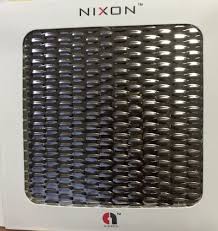 | Stainless Steel Embossed Sheets Specification Product Name Stainless Steel Products Steel Type Stainless Steel Steel Product Type Steel Sheets Grade 304 Thickness 0.5-3.0 Millimeter... View product → |
 | Stainless Steel Embossed Sheets Specification Product Name Stainless Steel Products Steel Type Stainless Steel Steel Product Type Steel Sheets Grade 304 Thickness 0.5-3.0 Millimeter... View product → |
Frequently asked questions
Where do color embossed stainless steel sheets work best in Mumbai properties?
They suit commercial entrances, lift surrounds, reception walls, retail interiors, food-service areas and other high-visibility zones where texture helps conceal minor marks.
How do you choose the surface, colour and material?
Compare texture, reflectivity, lighting, cleaning routines and surrounding materials, then select the colour and stainless steel grade for the application.
What thickness, backing and fabrication details prevent site problems?
Specify sheet thickness, substrate or backing, edge details, joint layout, fixing method, protective film and fabrication tolerances before production.
When does a Mumbai project need Grade 316 instead of Grade 304?
Choose Grade 316 for coastal salt exposure, chloride-heavy cleaning or locations where corrosion resistance matters more than the lower cost of Grade 304.
Related products
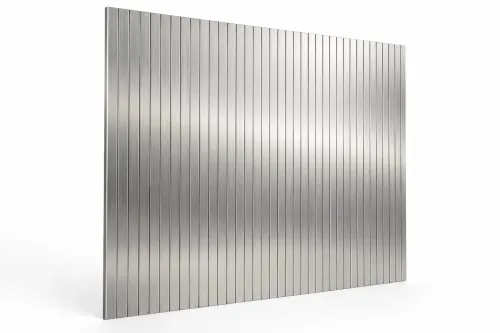
 | Stainless Steel Embossed Sheets Vertical Lines Embossed SS Sheets Specification Product Name Stainless Steel Products Steel Type Stainless Steel Steel Product Type Steel Sheets Grade 304 Thickness 0.5-3.0 Millimeter... View product → |
 | Stainless Steel Embossed Sheets Specification Product Name Stainless Steel Products Steel Type Stainless Steel Steel Product Type Steel Sheets Grade 304 Thickness 0.5mm-3.0mm... View product → |
 | Stainless Steel Embossed Sheets Specification Product Name Stainless Steel Products Steel Type Stainless Steel Steel Product Type Steel Sheets Grade 304 Thickness 0.5-3.0 Millimeter... View product → |
 | Stainless Steel Embossed Sheets Specification Product Name Stainless Steel Products Steel Type Stainless Steel Steel Product Type Steel Sheets Grade 304 Thickness 0.5-3.0 Millimeter... View product → |
Keywords