A bronze mirror sheet can look consistent on a sample and fail after cutting, bending, welding or installation because the visible colour comes from a thin coating over a polished stainless surface. You will be able to match the sheet to its fabrication method, protect the face, select a practical thickness and write an order specification that reduces shade, edge and replacement disputes.
Key takeaways
- Specify reflectivity, bronze tone and surface pattern before ordering.
- Use coated-face protection during cutting, drilling, handling and installation.
- Match sheet thickness and bend radius to the fabrication method.
- Confirm finish samples, tolerances, coating coverage and delivery details in writing.
Where bronze mirror sheets fit in Mumbai projects—and what appearance you are specifying
Specify the appearance before specifying the sheet. Bronze mirror stainless steel sheets suit:
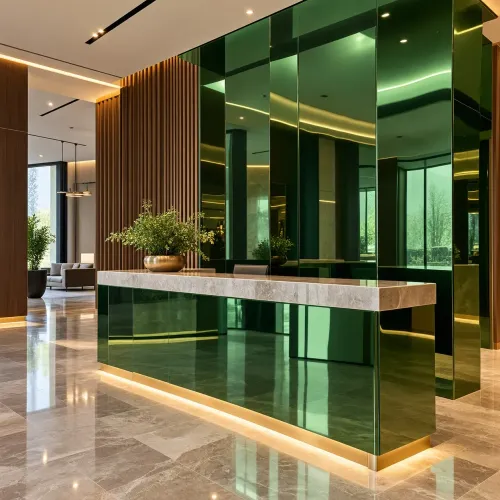
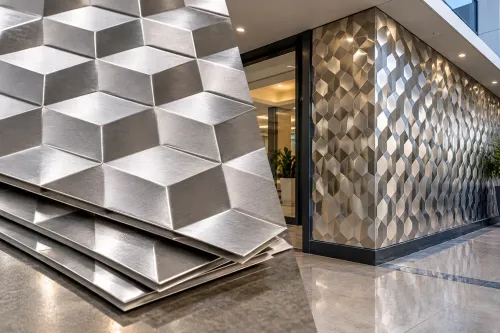
- Wall cladding and lift surrounds, where repeated panels create a warm reflective plane.
- Reception counters and columns, where the finish becomes a close-view feature.
- Shopfronts and signage backgrounds, where lighting exposes shade and surface defects.
- Furniture panels and ceiling details, where panel direction controls the reflected lines.
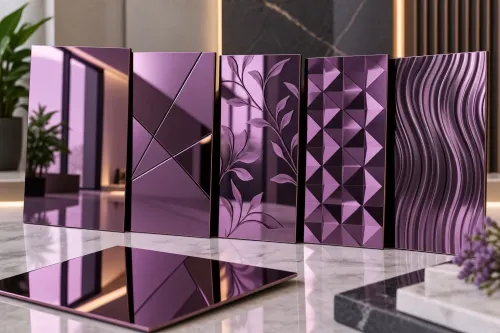
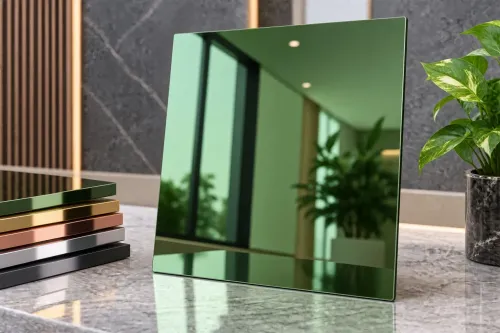
“Bronze” normally means a thin PVD colour deposited on stainless steel, not solid bronze. Do not order only “ss designer sheets bronze finish.” State the substrate grade, sheet thickness, mirror requirement, coating colour and coating batch on the purchase order.
No. 8 mirror and PVD are different processes:
| Process | Creates | Risk if confused |
|---|---|---|
| No. 8 mirror | Reflection through progressive polishing and buffing | A PVD layer will not hide waviness, roll marks or polishing lines |
| PVD | Bronze, champagne or rose-bronze colour coating | It does not create the mirror surface |
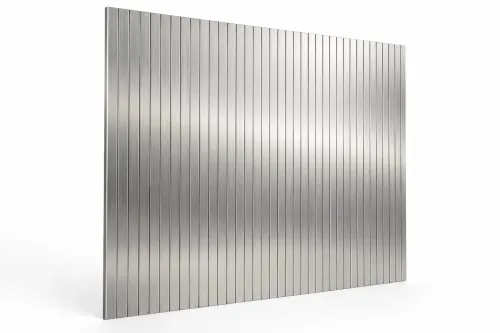
Polishing lines remain visible through the coating. Keep every panel oriented consistently; turning one sheet 90 degrees can change its apparent shade and reflectivity under showroom or façade lighting.
Approve a signed physical first-off panel, not a catalogue image. View it under the project lighting from the intended distance, because angle, light, polishing direction and production batch alter decorative colours. The approved panel becomes the control for subsequent sheets.
How to cut, drill and protect the coated face
Start with a signed cutting layout: mark the finished face, grain direction, holes, bends, edge allowances and the usable cut size before releasing any sheet to the machine.
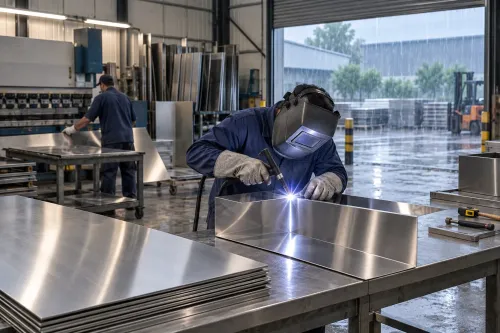
1. Keep the factory film on during cutting and routine installation handling. Place the sheet face-up on clean, soft, non-abrasive supports; never drag it across a steel table. Use laser cutting or shearing with sharp, deburred tooling, then remove swarf before it can rub into the bronze face.
2. Separate stacked sheets with clean interleaving material, not dusty cardboard or metal offcuts. For CNC routing or drilling, support the sheet evenly and lift or slide it without face contact; use a clean sacrificial board so chips cannot lodge beneath the panel.
3. Remove burrs with a controlled edge-finishing method, then inspect holes, cut edges and corners under the intended lighting. Keep film on through fabrication and installation, but remove it before prolonged sun, heat, moisture or adhesive exposure. Film limits handling damage; it does not prevent grit abrasion, heat marking, trapped moisture or adhesive residue.
4. Clean only with a mild chloride-free solution, a soft clean cloth and prompt rinsing, followed by drying. Abrasive pads, metal scrapers, grit, chloride cleaners and strong acids can permanently scratch or stain the mirror surface, while exposed edges remain vulnerable to chemical attack.
For pvd coated sheets for fabricators, isolate welding, brazing and high-temperature grinding from the coated face; use an uncoated allowance or plan post-work finishing, because polishing a burned coating will not recreate its original bronze appearance.
How thickness, bends and fixing methods change the result
Thickness follows the construction, not the colour or mirror finish.
| Construction | Thickness decision | Suitable fixing approach |
|---|---|---|
| Thin decorative skin | Use only with continuous support; a light sheet needs bonding or a rigid backing to prevent oil-canning | Full-area adhesive coverage or closely spaced mechanical fixings |
| Bonded panel | Choose a sheet that stays flat against a stable, moisture-resistant backing; control adhesive spread to avoid visible high and low spots | Approved adhesive, even coverage and temporary restraint while curing |
| Folded trim | Provide enough stiffness for the return, especially at exposed corners and long unsupported runs | Folded return with concealed clips, adhesive or mechanical fixings |
| Door or lift lining | Select for handling, impact and repeated cleaning rather than appearance alone | Mechanical fixing, cassette construction or bonded backing |
| Freestanding component | Treat the stainless sheet as a skin, not the structure; design a frame, stiffeners and load paths | Engineered supports with accessible, serviceable fixings |
Put the bronze face outward on a folded panel only after the specified bend radius and tooling pass a trial. Tight bends, deep forming and sharp hems can crack or delaminate the PVD coating even when the stainless survives.
Require one test piece before batch production. It must reproduce the exact bend direction, corner radius, drilling, folding and fixing method, including adhesive coverage and cure conditions.
Use mechanical fixings where access, impact or replacement matters; use adhesive where a clean face and stable backing permit controlled coverage. Welding, brazing and high-temperature grinding can burn or discolour the coating. Leave an uncoated allowance, remove coating from the heat-affected zone, or plan post-weld finishing; polishing alone will not restore the bronze appearance.
When bronze PVD is a better choice than other bronze-look materials
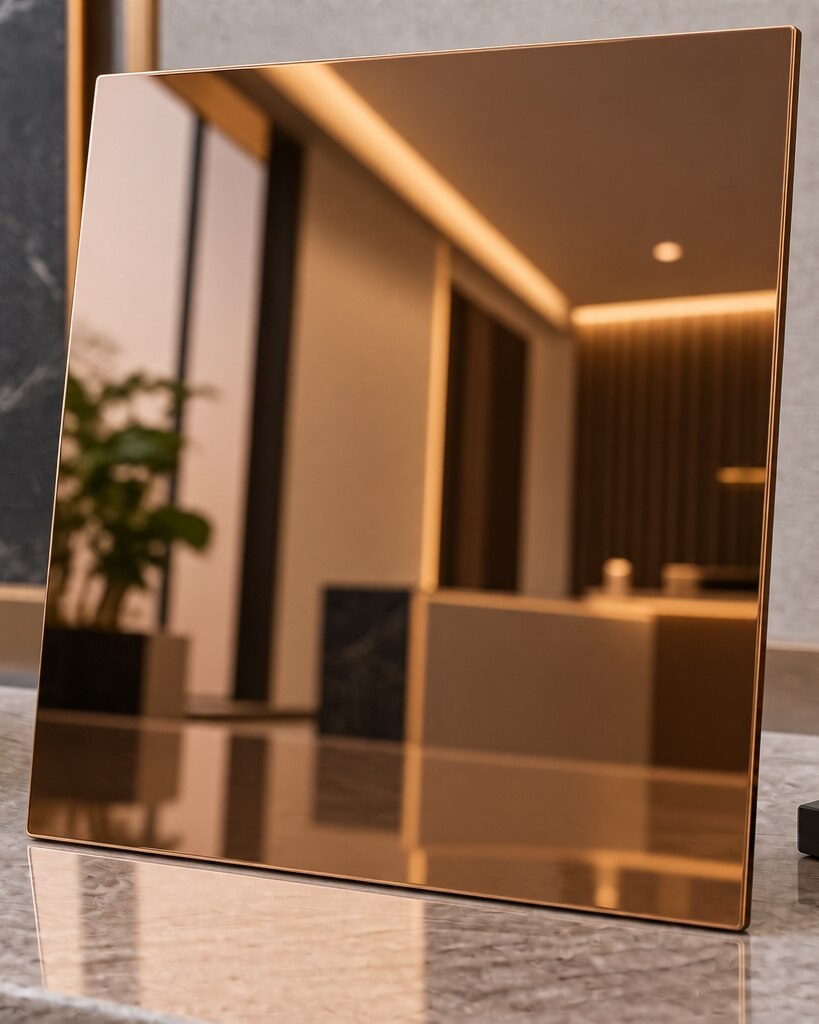
For bronze pvd sheets in mumbai, choose PVD when you need a genuine mirror reflection with a controlled bronze tone, not merely a brown surface. The mirror appearance comes from the polished stainless-steel surface; the bronze colour comes from a thin PVD coating.
A cut edge, drilled hole, weld zone or deep scratch can therefore expose a different-looking substrate.
| Material | Reflection and weight | Corrosion and repair | Cost control and fabrication effort |
|---|---|---|---|
| Bronze PVD stainless steel | Strongest mirror depth; medium weight | Grade-dependent; face damage needs replacement or specialist refinishing | Predictable sheet supply, but careful cutting, handling and orientation are essential |
| Bronze-coloured stainless steel | Usually softer or satin reflection; medium weight | Stainless base resists corrosion; colour matching after damage remains difficult | Moderate cost and fabrication effort |
| Bronze laminate | Low or printed reflection; light | Moisture can affect edges and adhesive; patches are visible | Low initial cost; easy cutting, limited for heat and wet areas |
| Anodised aluminium | Directional sheen; lightest option | Good oxide protection, but scratches expose aluminium | Efficient fabrication; mirror depth is limited |
| Painted metal | Gloss depends on paint; medium weight | Chips and corrosion spread from exposed steel; repainting leaves shade differences | Lowest initial cost, with simpler fabrication and higher touch-up risk |
| Actual bronze | Naturally warm, non-mirror unless polished; heavy | Patinas and requires controlled maintenance | Material cost and polishing effort are higher |
Specify 304, 316 or 430 for the site and cleaning regime. Consider 316 where chloride exposure is materially higher, such as coastal spray or salt-laden service areas. PVD is not an invisible on-site repair system: polishing corrosion-resistant base metal will not recreate the bronze face. Agree a replacement-sheet process or specialist refinishing route before installation.
What to confirm before ordering bronze mirror PVD sheets in Mumbai
Before ordering bronze mirror PVD sheets in Mumbai, put measurable acceptance criteria on the purchase order; “bronze mirror” alone leaves too much open to dispute.
1. Record sheet length, width, usable cut size, thickness, stainless grade, mirror requirement, polishing or reflection direction, flatness, corner radius and edge condition. State whether edges must be square, deburred, polished or concealed, and prohibit turning adjacent panels 90 degrees.
2. Identify the approved coating colour, physical control sample and PVD batch. Require consistent finish across sheets, factory protective film, separators, moisture-resistant packing and the number of replacement sheets available. Approve a sample after the exact cutting, edge polishing, bending, drilling and fixing process—not an untouched colour chip.
3. For exterior or high-traffic work, write down the inspection distance, lighting, allowable shade variation, acceptable face scratches, edge defects and repair policy. Define whether inspection occurs at 1 metre in diffuse daylight, for example, and whether any visible scratch or colour mismatch requires replacement rather than polishing.
Ask the supplier to sign the first-off panel before production. A catalogue image cannot control angle-dependent reflection, polishing lines or batch colour. Assess NIXON STEELIUM LLP against these documented dimensions, sample approval, packing records and replacement support—not catalogue wording alone.
If the proposed repair depends on polishing the damaged face, reject it unless the supplier documents a matching refinishing method.
Related products
 | PVD Coated Mirror Stainless Steel Sheets Specification Product Name Stainless Steel Products Steel Type Stainless Steel Steel Product Type Steel Sheets Grade 304 Thickness 0.5-3.0 Millimeter... View product → |
 | PVD Coated Mirror Stainless Steel Sheets PVD Coated Mirror Coloured Stainless Sheet Specification Steel Type Stainless Steel Steel Product Type Steel Sheets Grade 304 PVD Coated Mirror Coloured Stainless Sheet Trade Information... View product → |
Frequently asked questions
Where do bronze mirror PVD sheets fit in Mumbai projects?
They suit feature walls, lift surrounds, reception counters, partitions, ceilings, column cladding and other interior elements where you want a warm metallic reflection. Specify whether you want a clear mirror, softened reflection or patterned bronze surface.
How should you cut and drill bronze mirror PVD sheets?
Keep the protective film on the coated face, use sharp tooling suited to stainless steel, and prevent swarf from scratching the surface. Deburr cut edges, clean away metal particles, and avoid dragging sheets across worktables.
How do thickness, bends and fixing methods affect the finished result?
Thickness affects stiffness, weight and edge appearance. Confirm the minimum bend radius with the fabricator before forming, and choose adhesive, concealed clips, mechanical fasteners or a backing frame according to panel size, substrate and access for replacement.
When is bronze PVD a better choice than other bronze-look materials?
Bronze PVD on stainless steel gives a consistent metallic finish on a corrosion-resistant substrate without the maintenance and patina changes associated with solid bronze. Choose another material when you need authentic bronze mass, a deliberately changing patina or a different budget and fabrication process.
What should you confirm before ordering bronze mirror PVD sheets in Mumbai?
Confirm the stainless steel grade, thickness, sheet size, mirror clarity, bronze shade, surface protection, usable finished area, edge treatment, quantity, sample approval, coating coverage, inspection requirements and delivery schedule.
Keywords